Table of Contents
Curious About Your Brain Waves?
Discover how qEEG brain mapping can evaluate your cognitive function and relaxation states.
Explore Brain Mapping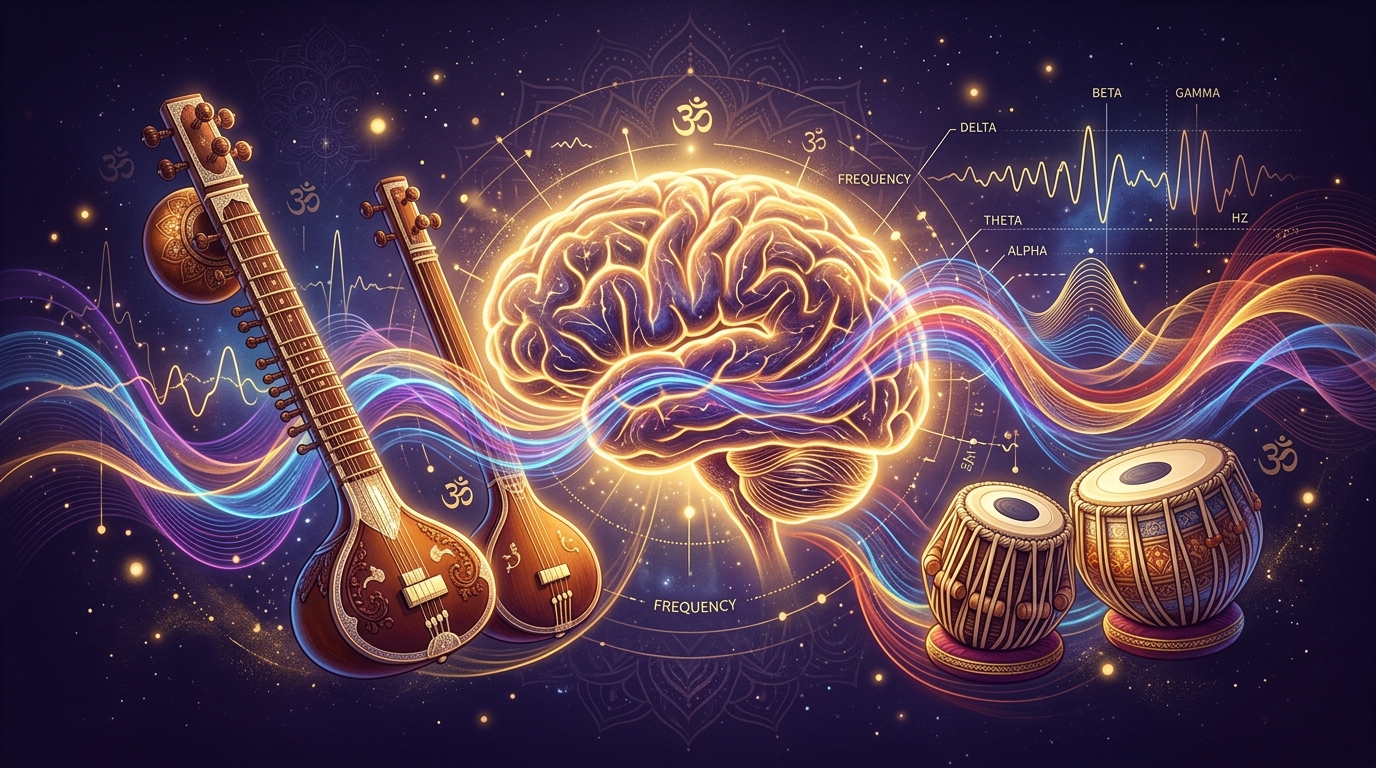
For thousands of years, classical Indian music has been practiced, preserved and passed from one generation to another. Its intricate melodies, rhythms and improvisational traditions have long been associated with concentration, emotional expression, meditation and a sense of connection.
But what actually happens inside the brain when we listen to this music?
That question was at the heart of a unique cultural and scientific event hosted by the Sunder Foundation alongside Karma TMS, bringing together Indian classical musicians, neuroscience and community in an evening designed to explore the relationship between music, the human brain and mental wellbeing.
The event brought together musical traditions from both Northern and Southern India, alongside a cross-cultural collaboration featuring renowned saxophonist George Brooks. While the evening celebrated India’s rich musical heritage, it also provided an opportunity to explore an increasingly interesting question in neuroscience: Can music influence the way our brain functions — and could understanding that relationship help us better understand relaxation, focus and overall brain health?
Key Scientific Inquiry
"How does the brain respond to centuries-old musical traditions, and can real-time EEG brain mapping reveal the neurological signature of relaxation and flow states?"
Music, Neuroscience and the Human Brain
Music is far more than sound waves hitting the eardrum.
When we listen to music, multiple areas of the brain can become involved simultaneously, including complex neural networks associated with auditory processing, emotion, memory, attention, executive function, and movement.
The emotional response to music can also be highly individual. A particular melody may trigger vivid memories, create a deep feeling of calm, encourage rhythmic movement, or simply help someone become fully absorbed in the present moment.
At the Karma TMS and Sunder Foundation event, this connection between music and the brain became the focus of a live scientific demonstration. As one participant described the purpose of the evening, the goal was to “elevate our vibrations” and potentially help people enter a state of flow, connection, and ease while temporarily disconnecting from the busyness of everyday life.
That experience was not simply discussed conceptually — it was observed in real time through quantitative brain mapping.
Measuring the Brain During a Live Indian Classical Music Performance
As musicians performed live, neuroscientist and sleep specialist Dr. Cameron Good participated in an EEG brain-mapping demonstration on stage.
Using a specialized electroencephalogram (EEG) cap equipped with precision sensors, Dr. Good listened attentively to the live classical performance while researchers observed real-time changes in spectral brain activity.
Live Event Demonstration: Classical Indian Music & EEG Brain Mapping
Watch the live EEG recording session hosted by Karma TMS and the Sunder Foundation.
Key Finding: Increase in Alpha Brain-Wave Activity
According to the event's presentation, the live EEG recording showed a notable increase in alpha brain-wave activity during the classical Indian musical performance. This shift signaled a transition toward relaxed wakefulness and focused calmness.
Alpha activity is commonly associated with relaxed wakefulness and has been studied extensively in relation to attention, relaxation, meditation, and cognitive flexibility.
This observation provides an intriguing starting point for exploring the relationship between classical Indian music and brain activity. However, it is essential to maintain scientific rigor: one EEG demonstration should not be interpreted as proving that classical Indian music treats a medical condition or produces the exact same neurological response in every individual.
Instead, it raises a compelling scientific question: What can we learn by studying how different forms of complex music affect brain wave frequencies and neural connectivity?
What Are Alpha Brain Waves?
Alpha waves are a type of electrical brain activity that typically fall within the 8–12 Hz frequency range. They represent a rhythmic oscillation produced by synchronous electrical activity in brain cells.
Alpha waves are most commonly observed when a person is awake but deeply relaxed — particularly when the eyes are closed and the individual is not actively processing demanding external or high-stress information.
Frequency Range
Oscillating between 8 and 12 cycles per second, bridging conscious thought (Beta) and deep sleep/meditation (Theta/Delta).
Relaxed Wakefulness
Indicates a calm, lucid state of mind where stress hormones decrease and cognitive clarity is restored.
Attention & Gating
Helps filter out irrelevant sensory distractions, allowing sustained focus without tension.
Stress Reduction
Increased alpha power is strongly linked to reduced anxiety, improved mood regulation, and enhanced restorative rest.
Researchers across neuroscience and clinical psychiatry study alpha activity in connection with relaxation, attention filtering, sensory processing, meditation, stress reduction, cognitive states, and sleep-wake transitions.
The increase in alpha activity observed during the Karma TMS event provides an intriguing neurological perspective on what attendees were experiencing subjectively. People weren't simply describing the live performance as calming — the event provided an opportunity to observe actual measurable changes in brain activity as the music unfolded.
Can Music Help Us Relax?
The relationship between music and relaxation has been studied extensively, although human responses vary depending on individual background, musical characteristics, and environmental context.
Factors such as tempo, rhythm, harmonic structure, familiarity, personal memories, and cultural associations all play a role in how an individual's nervous system responds to auditory stimuli.
Classical Indian music offers an especially interesting domain for neuroscience study because many of its foundational traditions involve sustained attention to melody (Raga), microtonal variations (Swaras), intricate rhythm (Tala), continuous drone (Tanpura), and spontaneous improvisation.
For listeners familiar with the tradition, these elements can create a deeply immersive experience. For listeners new to the genre, the unfamiliarity itself can spark novelty and mindful engagement, drawing attention away from repetitive everyday thoughts.
From Flow State to Brain Health
One of the core psychological concepts highlighted during the event was the concept of a flow state — a state of optimal immersion and deep engagement where a person's attention becomes highly focused, self-consciousness quietens, and awareness of temporal distractions decreases.
Attentive music listening can serve as a powerful catalyst for entering flow. The combination of live acoustic performance, communal presence, and active listening creates an environment where individuals can step away from the relentless stimulation of modern digital life.
"Experiences like this help us think about mental health and quality of life not only in terms of treating illness, but also in terms of actively maintaining a healthy brain and a healthy lifestyle."
— Dr. Cameron Good, Neuroscientist & Sleep SpecialistThat distinction is profound. Brain health is not simply the absence of mental illness.
Brain health encompasses restorative sleep, cognitive flexibility, emotional regulation, social connectedness, stress management, neuroplasticity, and engaging in activities that bring deep meaning and presence to life.
Why Indian Classical Music Is Interesting to Neuroscience
Indian classical music provides a rich subject for cognitive neuroscientists because of its complex mathematical structures and thousands of years of systemic refinement.
Hindustani Tradition
Originating in Northern India, Hindustani classical music emphasizes gradual modal development (Alap), emotional mood evocative of specific times of day or seasons, and elaborate rhythmic dialogues.
Carnatic Tradition
Originating in Southern India, Carnatic music features rich composition structures (Kritis), intricate rhythmic cycles (Tala patterns), and dynamic microtonal ornamentations.
By bringing Hindustani and Carnatic masters together with Western jazz saxophonist George Brooks, the event demonstrated how different musical systems interact. Rather than treating art and neuroscience as separate domains, the evening illustrated how artistic expression and scientific inquiry can illuminate each other.
The Connection Between Music, Emotion and Memory
Music has a unique ability to evoke powerful emotional and memory responses almost instantaneously. A single melody can transport someone to a specific moment from decades past; a specific instrument can evoke deep cultural heritage; a subtle shift in key or rhythm can alter heart rate and attentional focus.
These responses occur because music activates neural circuits far beyond the primary auditory cortex — engaging the limbic system (emotion), hippocampus (memory), motor cortex (movement), and prefrontal cortex (executive processing).
This multi-system engagement explains why music has been central to human culture, healing rituals, and community bonding across millennia. The Karma TMS and Sunder Foundation event provided a modern lens through which to observe this timeless human experience.
Where Neuroscience Meets Culture
Perhaps the most vital insight from the event was that science and culture do not need to exist in separate silos.
- Neuroscience gives us objective tools (like EEG and qEEG brain mapping) to investigate brain activity.
- Music offers a rich, expressive human experience through which those questions can be explored.
- Community creates the warm environment in which these shared experiences become meaningful.
Together, they form a holistic model for considering mental wellbeing — one that honors both ancient human wisdom and modern empirical science.
Could Music Become Part of a Healthy Lifestyle?
In daily life, people already turn to music for diverse needs:
- Relaxation after work: Transitioning from high-stress work environments to calm states.
- Exercise & energy: Enhancing physical activity, endurance, and mood.
- Focus & study: Facilitating concentration and sustained cognitive attention.
- Meditation & sleep: Promoting relaxation and restorative sleep hygiene.
- Social connection: Building community bonds through shared musical experiences.
- Emotional processing: Providing a creative outlet for self-expression and emotional regulation.
- Cultural connection: Honoring heritage, memory, and traditional artistic identity.
- Stress relief: Reducing anxiety and lowering physiological stress markers.
Understanding how different musical structures influence brainwave activity could help clinicians and wellness practitioners tailor music-based practices to support mental clarity, stress reduction, and sleep hygiene.
This does not mean listening to music replaces medical or psychiatric treatment for clinical disorders. Rather, it highlights that brain health is influenced by a combination of biological, psychological, social, and lifestyle factors.
The Future of Brain Health May Be Multidisciplinary
The work being explored by organizations such as Karma TMS and the Sunder Foundation reflects a growing movement toward integrated, multidisciplinary brain health.
At Karma TMS, clinical care centers on advanced neuromodulation therapies — including FDA-cleared TMS therapy and Personalized PRTMS® — to treat conditions like depression, anxiety, OCD, and PTSD. Events like this cultural collaboration highlight how clinical neuroscience can also intersect with lifestyle habits, art, and community.
The question isn't simply whether music can “heal” the brain. The more compelling question is: How does the brain respond to music, and what can those responses teach us about human wellbeing?
From Ancient Tradition to Modern Neuroscience
Classical Indian music has survived for thousands of years because generations of listeners have found profound beauty, spiritual grounding, and emotional connection within its soundscapes.
Modern neuroscience gives us another way to appreciate that experience. By placing EEG technology alongside a live Indian classical music performance, Karma TMS and the Sunder Foundation created an opportunity to connect an ancient cultural tradition with contemporary scientific inquiry.
The increase in alpha activity observed during the event offers an intriguing glimpse into that relationship — while also reminding us that much remains to be explored.
Perhaps the most valuable outcome wasn't a definitive answer. It was a new question.
What else can we discover about the human brain when science, music and culture come together?
For Karma TMS and the Sunder Foundation, that question represents an opportunity to continue exploring the connection between neuroscience, mental wellbeing, brain health and quality of life.
And sometimes, understanding the brain may begin simply by listening.
Frequently Asked Questions & Key Takeaways
About the Author
Dr. Keerthy Sunder
Board-Certified Psychiatrist | KarmaTMS
Dr. Keerthy Sunder is a board-certified psychiatrist specializing in TMS therapy and integrative psychiatry. He is passionate about bringing advanced, evidence-based treatments to the Palm Springs community to help patients achieve lasting mental wellness.
Explore Advanced Brain Health & Neuromodulation
Interested in learning more about your brain function or searching for non-invasive treatment options for depression and anxiety? Schedule a consultation with the specialists at Karma TMS.