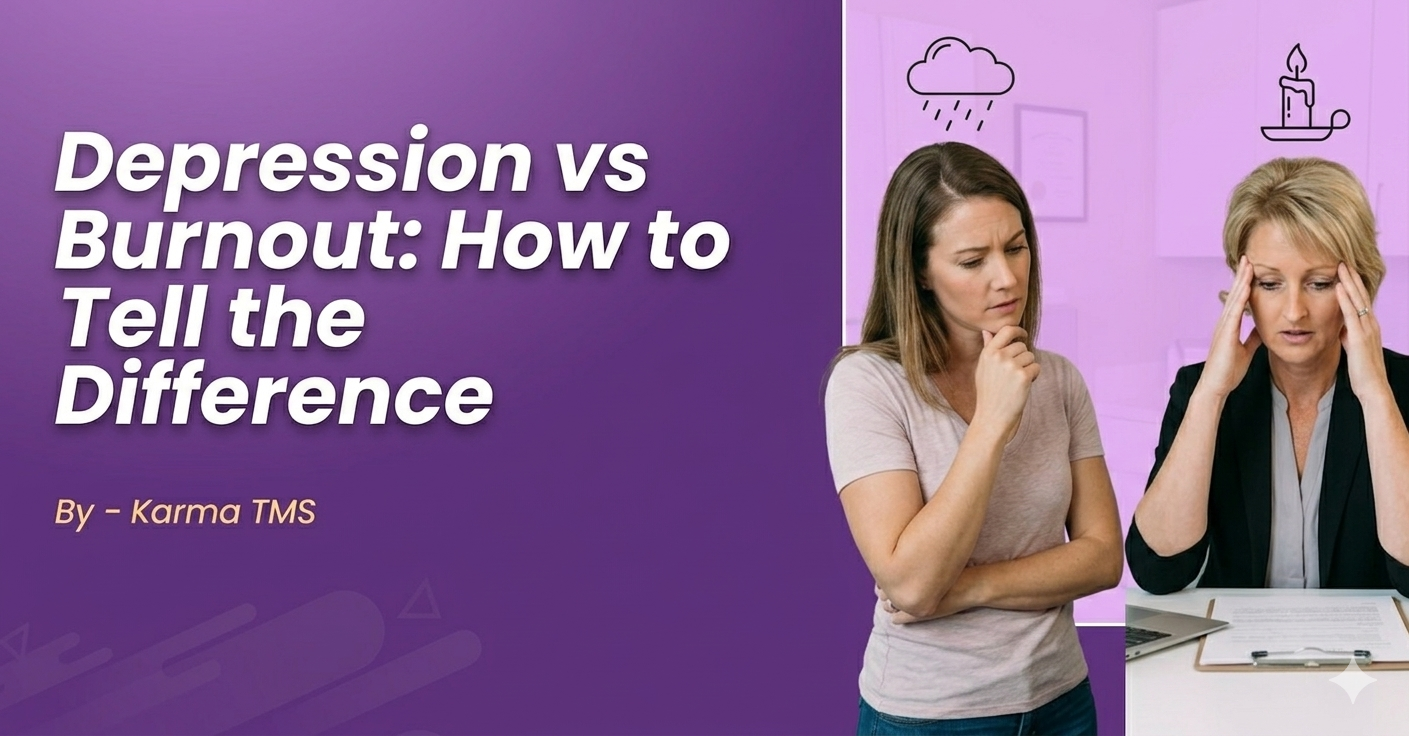
You're exhausted, unmotivated, emotionally numb, and dreading each new day. But is what you're experiencing clinical depression — a neurobiological disorder — or burnout, the result of prolonged, overwhelming stress? The answer matters enormously, because while the symptoms can look remarkably similar, the underlying mechanisms and the most effective treatments differ significantly.
Confusing depression with burnout — or vice versa — can lead to months or years of using the wrong recovery strategy. Someone with clinical depression who only takes a vacation will likely return just as depleted as they left. Someone with burnout who is immediately put on antidepressants without addressing root-cause stressors may cycle through medications without real relief.
This guide provides a comprehensive, clinically grounded comparison to help you understand what you're experiencing and what your next steps should be.
In This Article You Will Learn:
- The WHO's clinical definition of burnout
- The DSM-5 criteria for clinical depression
- A symptom-by-symptom comparison
- The critical diagnostic tests to differentiate them
- Treatment strategies for each condition
- When to seek professional psychiatric care
What Is Burnout?
Burnout was officially classified as an occupational phenomenon by the World Health Organization (WHO) in 2019, included in the ICD-11 as a syndrome resulting from chronic workplace stress that has not been successfully managed.
The WHO defines burnout through three core dimensions:
Energy Depletion
Feelings of exhaustion and being completely drained of physical and emotional resources
Increased Mental Distance
Cynicism, negativism, or detachment from one's job and the people at work
Reduced Efficacy
Diminished sense of professional accomplishment and confidence in one's abilities
Important Nuance
Burnout, by the WHO's definition, is context-specific. It refers to phenomena in the occupational context specifically and is not classified as a medical condition or mental disorder. This is a critical distinction when it comes to treatment.
Beyond classic workplace burnout, clinicians frequently see burnout triggered by other chronic overload contexts: caregiver burnout, parental burnout, and academic burnout all share the same core triad of exhaustion, cynicism, and reduced efficacy.
Common Burnout Symptoms
- Persistent exhaustion that doesn't improve with rest
- Cynicism, detachment, or resentment toward work or responsibilities
- Decreased productivity and difficulty concentrating at work
- Feeling like everything is a chore; dreading going to work
- Irritability, short temper, or emotional outbursts
- Physical symptoms: frequent illness, headaches, muscle tension
- Neglecting personal needs (skipping meals, poor sleep, social isolation)
- Questioning the meaning or value of your work
Key distinguishing feature of burnout: These symptoms are primarily tied to one domain (usually work or a specific caregiving role). Remove or significantly reduce that stressor, and the person typically begins to recover.
What Is Clinical Depression?
Major Depressive Disorder (MDD) is a recognized medical condition in which disruptions in brain chemistry — particularly involving serotonin, norepinephrine, and dopamine systems — produce a pervasive and persistent low mood that affects virtually every domain of a person's life.
According to the American Psychiatric Association, MDD is diagnosed when a person experiences at least 5 of the following 9 symptoms nearly every day for at least 2 consecutive weeks:
Key distinguishing feature of depression: Symptoms are pervasive — they bleed into all areas of life, not just work. Even activities once loved (family time, hobbies, vacation) bring little to no joy. Depression persists regardless of circumstances.
Depression vs Burnout: A Side-by-Side Comparison
| Feature | 🔥 Burnout | 🧠 Clinical Depression |
|---|---|---|
| Primary Cause | Chronic unmanaged stress (usually occupational) | Neurobiological disorder; may be triggered by stress or appear without clear cause |
| Emotional State | Emotionally flat, detached, cynical | Profound sadness, emptiness, hopelessness |
| Self-Worth | May feel incompetent at work, but self-worth intact outside work | Pervasive worthlessness, shame, or excessive guilt across all areas of life |
| Motivation | Loss of motivation specifically related to work or stressor | Loss of motivation for nearly all activities including previously enjoyed ones |
| Response to Rest | Significant improvement after extended rest, vacation, or removal from stressor | Little to no improvement even after rest or positive circumstances |
| Anhedonia | Still capable of enjoyment in non-work settings | Pervasive inability to feel pleasure in virtually any domain |
| Physical Symptoms | Fatigue, frequent illness, headaches | Same, plus significant appetite/weight changes, psychomotor changes |
| Thoughts of Death | Not typically present | May include passive death wishes or active suicidal ideation |
| Duration Without Intervention | Improves with lifestyle changes and rest; may persist if stressors remain | Tends to persist or worsen without clinical treatment |
| Primary Treatment | Rest, stress management, boundary-setting, coaching | Psychotherapy, medication, TMS therapy, or combination |
The Three Most Important Diagnostic Questions
When trying to self-evaluate whether you're dealing with burnout or depression, these three questions can provide important clarity:
1. Does your low mood lift in enjoyable, non-work situations?
If yes → Points more strongly toward burnout. Your brain's reward circuitry is still functional; the problem is domain-specific exhaustion and chronic stress.
If no → Points toward clinical depression. Anhedonia (inability to feel pleasure) across all domains is a hallmark of MDD, not burnout.
2. Did a meaningful vacation or break help — even temporarily?
If yes → Points toward burnout. Rest temporarily restoring function is characteristic of exhaustion-based syndromes.
If no → Points toward depression. Clinical depression is neurobiological and does not respond meaningfully to situational change alone.
3. Do you feel worthless as a person — not just as a worker?
If no → More consistent with burnout. Your professional self-image may be shattered but your core sense of self is intact.
If yes → More consistent with depression. Pervasive feelings of worthlessness, shame, or guilt are a clinical depression hallmark, not a burnout feature.
Clinical Reminder
These questions are meant to guide reflection, not replace professional diagnosis. If you are unsure, the safest and most helpful step is always a formal evaluation with a psychiatrist or mental health professional.
When Burnout and Depression Overlap
Here is an important clinical reality: burnout and depression are not mutually exclusive. In fact, research published in Frontiers in Psychiatry highlights significant symptom overlap between the two conditions, and studies suggest that burnout may be a risk factor for the eventual development of clinical depression in genetically vulnerable individuals.
The progression often looks like this:
- Chronic workplace or life stress → Burnout symptoms emerge
- Burnout goes unaddressed → Cortisol dysregulation, sleep disruption, social withdrawal
- Prolonged physiological stress → Neurochemical changes in the brain's mood centers
- Burnout evolves into or triggers clinical depression in predisposed individuals
When both are present simultaneously, treatment must address both: the clinical depression requires medical/psychiatric intervention (like TMS therapy or antidepressants), while the burnout requires systemic changes — workload reduction, boundary setting, and recovery practices. Treating only one when both exist will produce incomplete results.
Treatment Approaches: Burnout vs. Depression
For Burnout Recovery
- Rest & recovery — Extended time away from the stressor
- Boundary setting — Learning to say no and protect your time/energy
- Coaching or therapy — Addressing work-life balance and values alignment
- Lifestyle adjustments — Exercise, sleep hygiene, nutrition, community. See our guide on stress management
- Organizational changes — Workplace accommodations, role adjustments, or career transitions
For Clinical Depression
- Psychotherapy (CBT/DBT) — Evidence-based talk therapy targeting thought and behavior patterns
- Antidepressant medication — Under careful medication management
- TMS therapy — FDA-cleared brain stimulation for treatment-resistant cases
- PrTMS — Personalized, EEG-guided TMS for maximized brain-specific outcomes. Learn about PrTMS
- Lifestyle support — Complementary to clinical treatment, not a replacement
At Karma TMS, we treat patients dealing with both burnout-triggered and standalone clinical depression using the most advanced, evidence-based tools available in Palm Springs and Rancho Mirage. Our integrated approach combines thorough psychiatric evaluation with brain mapping, TMS or PrTMS, and collaboration with your existing therapy team.
Not sure which condition you're dealing with? The most important thing you can do right now is to schedule a free consultation with a qualified psychiatrist who can provide a proper assessment and personalized treatment recommendation.
Frequently Asked Questions: Depression vs. Burnout
Not Sure Which You're Dealing With?
Our team of experienced psychiatrists in Palm Springs can provide a comprehensive evaluation to determine whether you're experiencing burnout, depression, or both — and build a personalized treatment plan around your specific needs.
Related Articles
The Four A's of Stress Management
Practical stress management techniques to help you avoid, alter, adapt, and accept.
Read More
Signs Your Depression Needs Professional Treatment
10 warning signs that your depression has crossed the threshold for clinical care.
Read More
TMS for Treatment-Resistant Depression
When antidepressants aren't enough, TMS offers evidence-backed hope.
Read More
About the Author
Dr. Keerthy Sunder
Board-Certified Psychiatrist | KarmaTMS
Dr. Keerthy Sunder is a board-certified psychiatrist specializing in TMS therapy and integrative psychiatry. He is passionate about bringing advanced, evidence-based treatments to the Palm Springs community to help patients achieve lasting mental wellness.