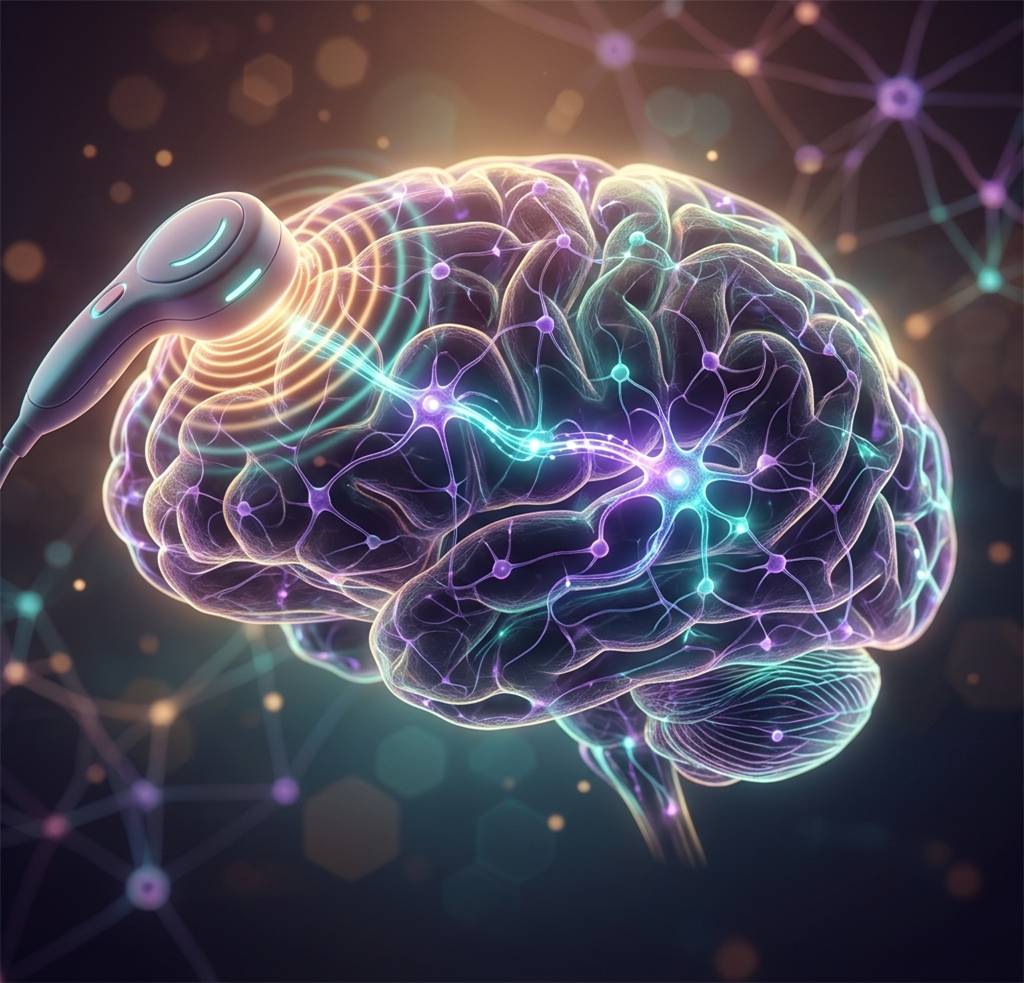
For most patients walking into their first TMS therapy session, the experience feels almost anticlimactic. A coil sits against your scalp, you hear a rhythmic clicking, and twenty minutes later you walk out and drive yourself home. But behind that quiet exterior, something extraordinary is happening at the cellular level — and it explains why TMS succeeds where decades of antidepressant medication often fail.
This guide walks you through exactly what happens inside your brain during those twenty minutes — the magnetic pulse, the neural firing, the long-term rewiring — in plain English, with no jargon and no sales pitch. By the end you will understand why TMS is fundamentally different from any pill you have ever swallowed. If you are wondering whether TMS is right for you, our 2-minute candidacy quiz can help.
The Setup: What's Happening Before the First Click
Before your first session, your Karma TMS clinician takes careful measurements of your head to pinpoint your motor threshold — the minimum stimulation intensity that produces a visible twitch in your hand. That number tells the technician your brain's individual excitability level.
The TMS coil — a figure-eight-shaped electromagnetic device — is then positioned over your left dorsolateral prefrontal cortex (DLPFC). That positioning is precise to the millimeter. The coil never touches your brain. It does not need to. The magnetic field passes through your scalp and skull as easily as light passes through glass, focusing energy in a targeted cortical zone roughly 2–3 cm beneath the surface.
That millimeter-level coil positioning is the difference between effective treatment and an ineffective one. It is also why a board-certified psychiatrist — not a technician alone — should oversee your treatment plan.
The Magnetic Pulse: Faster Than a Lightning Strike
Each individual TMS pulse lasts less than a millisecond — shorter than the blink of an eye. The coil generates a brief, powerful magnetic field (roughly 1.5–2 Tesla, comparable to an MRI) that changes so rapidly it induces a tiny electrical current in the neurons beneath it. That current is enough to depolarize the cell membrane and trigger an action potential: the neuron fires.
In standard repetitive TMS for depression, pulses are delivered in rapid trains — typically 10 pulses per second for 4 seconds, followed by a short pause, repeated for the full 20-minute session. By the time the session ends, roughly 3,000 magnetic pulses have been delivered to that one cortical region. The same approach is also FDA-approved for OCD and is being studied for anxiety disorders and PTSD.
By the Numbers — A Single Session
- ~3,000 magnetic pulses delivered per session
- Each pulse lasts under 1 millisecond
- Penetration depth: 2–3 cm below the scalp
- Target zone: roughly 1–2 cm³ of cortical tissue
- No sedation, no systemic drug exposure, zero downtime
Neurons Fire, Then Wire Together
A single session of TMS produces temporary changes in cortical excitability. The real transformation happens across the full treatment course through a process called long-term potentiation (LTP) — the same mechanism responsible for all learning and memory formation in the brain.
When the DLPFC is stimulated repeatedly at the right frequency, the synaptic connections between its neurons — and between the DLPFC and deeper mood-regulating structures like the amygdala, hippocampus, and anterior cingulate cortex — become stronger and more efficient. The brain literally rewires itself. Circuits that were chronically underactive in depression begin to fire more readily. Over time, that new activity pattern becomes the brain's new default.
This is why TMS works better across a full course rather than as a one-off treatment, and why the effects can last months to years after the final session — the brain has been structurally changed, not just temporarily medicated. For most patients, noticeable improvement begins within a few weeks of consistent treatment.
Why the Left DLPFC? The Science Behind the Target
The left dorsolateral prefrontal cortex is the brain's emotional regulator. It governs executive function, working memory, and — critically — the top-down suppression of the amygdala's fear and threat responses. In patients with major depressive disorder, neuroimaging studies consistently show reduced metabolic activity in the left DLPFC. The brain's "dimmer switch" for emotional distress is stuck in the low position.
High-frequency rTMS (10 Hz) applied to the left DLPFC is excitatory — it turns the dimmer up. Low-frequency TMS (1 Hz) applied to the right DLPFC is inhibitory — it quiets an overactive mirror region on the other side. Both approaches restore the balance that healthy mood regulation requires.
1 Magnetic Field Generated
The figure-8 coil produces a 1.5T field that passes through skull tissue without impedance.
2 Electrical Current Induced in Cortex
The rapidly changing magnetic field generates a focal micro-current in DLPFC neurons 2–3 cm below the surface.
3 Action Potentials Fire
Neurons depolarize and fire — activating the underactive prefrontal circuit at the heart of depression.
4 Long-Term Potentiation Over Weeks
Repeated stimulation strengthens synaptic connections via LTP — the brain rewires its default mood state.
PrTMS: When Your Brain Gets Its Own Map
Standard TMS targets the same anatomical landmark in every patient. PrTMS — Personalized Repetitive TMS, the protocol offered at Karma TMS — goes further. Before treatment begins, a quantitative EEG (qEEG) records your brain's electrical activity across 19 electrode sites simultaneously, generating a full map of your individual cortical activity patterns.
A patented algorithm then analyzes which frequencies are dysregulated in your specific brain, identifies the optimal stimulation site and pulse frequency for your neural profile, and recalibrates the treatment plan weekly as your brain responds.
For patients across Palm Springs, Rancho Mirage, Twentynine Palms, and the surrounding desert region, Karma TMS is one of the few clinics in Southern California offering this level of neurological precision. Our board-certified psychiatry team oversees every PrTMS protocol from initial qEEG mapping to final tapering session.
What You Actually Feel During a Session
Most patients describe the sensation as a rhythmic tapping or knocking against the scalp — like someone lightly rapping their knuckles at a fast, even tempo. Some notice a mild tingling or pulling sensation in the scalp muscles. A small number of patients experience mild headache in the first few sessions; this almost universally resolves within the first week.
What you will not feel: sedation, confusion, disorientation, or any meaningful cognitive impairment. You remain fully awake and alert. Many patients bring a podcast. Some take a brief nap. When the 20 minutes end, you get up, collect your things, and drive yourself wherever you need to go next.
What's Changing in Your Brain Session by Session
The transformation is not sudden — and understanding that helps patients stay the course during the early sessions when the benefits have not yet become obvious.
Sessions 1–5: Calibration and Cortical Sensitization
The brain is learning to respond to the stimulus. Cortical excitability is being recalibrated. At this stage, the changes are happening below the threshold of conscious awareness. No mood lift is expected yet, and its absence does not indicate the treatment is not working.
Sessions 6–15: Early Neuroplastic Changes
Synaptic connections in the DLPFC and its downstream networks begin to strengthen. Some patients start noticing subtle shifts — slightly better mornings, less emotional heaviness, marginally improved motivation. Sleep quality often improves at this stage before mood fully lifts.
Sessions 16–36: Full Therapeutic Response
The LTP-driven rewiring reaches a clinically meaningful threshold. Patients in this phase typically report the clearest improvement — reduced depressive symptoms, better cognitive clarity, renewed interest in activities, and a noticeably different emotional baseline.
Frequently Asked Questions
Conclusion
TMS is not a black box and it is not magic. It is a precise, FDA-cleared neurological intervention that directly activates the brain circuit at the heart of depression. Over a full course of treatment, your brain physically rewires itself — and that change can outlast medication by months or years.
At Karma TMS, our board-certified psychiatrists handle the full process — from insurance verification to brain mapping to the final tapering session. If you are ready to find out whether TMS is right for you, we are here to help. Learn more about TMS safety or read about the documented success rates.
Ready to See What TMS Can Do for Your Brain?
Schedule a free consultation with our board-certified psychiatrists in Palm Springs, Rancho Mirage, or Twentynine Palms.
Related Articles

Why TMS Works When Antidepressants Don't
A psychiatrist explains why TMS succeeds where medication often fails.
Read More


About the Author
Dr. Keerthy Sunder
Board-Certified Psychiatrist | KarmaTMS
Dr. Keerthy Sunder is a board-certified psychiatrist specializing in TMS therapy and integrative psychiatry. He is dedicated to helping patients in Southern California find lasting relief from depression, anxiety, and treatment-resistant mental health conditions.